
When Speed Steals Meaning from Travel
A reflection on how speed reshapes not only the places we pass through, but the people we become while travelling. An invitation to slow down, restore relationship, and rediscover travel as an act of presence rather than consumption.
REGENERATIVE TRAVEL
Michel eganya
1/27/20265 min read
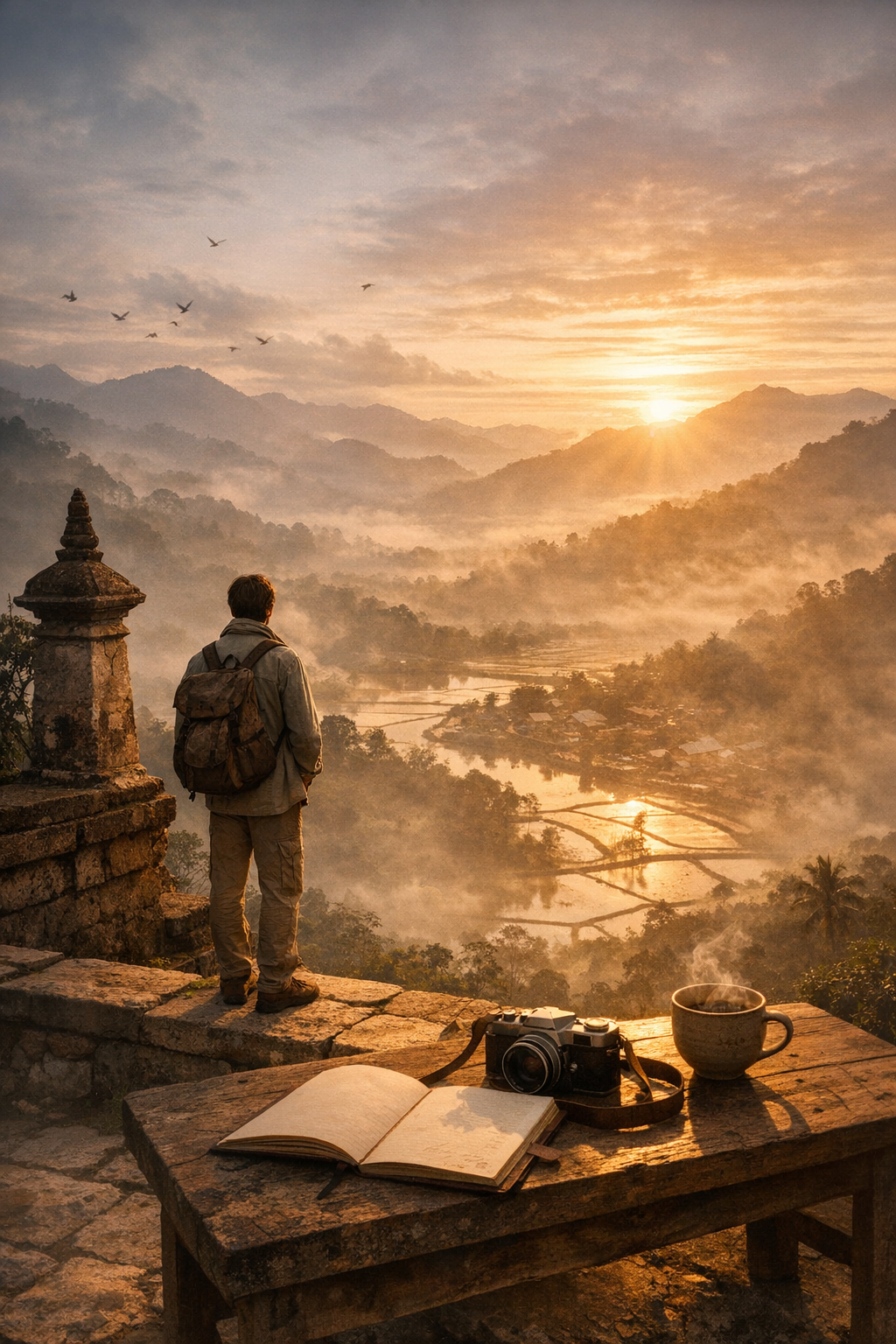
When Speed Steals Meaning from Travel
What We Lose When Travel Becomes Fast
There is a particular kind of tiredness that arrives when we move too quickly through beautiful places.
It is not the tiredness of walking. It is not even the tiredness of logistics. It is the quieter fatigue of never quite arriving, of collecting moments without letting any of them change us.
Fast travel promises efficiency. It promises range. It promises that we can fit more life into the same number of days.
But travel was never meant to be a method for extracting maximum experience from limited time. When it becomes that, something in us begins to harden. We start to treat the world as a sequence of scenes, and ourselves as the ones entitled to move through them without consequence.
The cost is not only environmental. The cost is human.
The speed that follows us
Many people do not travel to rest. They travel with the same inner posture they bring to work.
They arrive with urgency. They carry invisible deadlines. They plan with the logic of productivity. They measure the day by what has been “done.”
Even in places that invite softness, they remain braced.
This is not a moral failure. It is a cultural inheritance. We have been trained to believe that time is a problem to solve, not a reality to inhabit.
So we move quickly. We take the photo. We note the restaurant. We tick the landmark. We keep going.
And somewhere underneath, a quieter question waits.
What if the point of travel is not to see more, but to see differently?
When places become backdrops
A place is not a product. It is not a setting for our story.
A place is a living web of relationships. Land, weather, history, language, work, grief, celebration, seasons, memory. People who belong to it, and people who have been displaced from it. Species that depend on it. Watersheds that hold it.
When we move through a place quickly, we tend to reduce it. We simplify it so it can fit inside our schedule.
We notice what is easy to notice. We consume what is easy to consume.
We do not mean harm. But we also do not make contact.
And without contact, respect becomes abstract.
This is one of the hidden dangers of speed. It makes it possible to feel like a good person while remaining untouched.
The difference between seeing and meeting
There is a difference between seeing a landscape and meeting it.
Seeing is visual. Meeting is relational.
Meeting requires time. It requires repetition. It requires the humility of not understanding immediately. It requires the willingness to be slightly bored, slightly uncertain, slightly out of rhythm.
Most people fear boredom while travelling. They treat it as waste.
But boredom is often the doorway. It is what appears when the nervous system stops being entertained. It is what appears when the mind runs out of novelty and has to return to presence.
In that return, something becomes possible.
You begin to notice the way the light changes at the same hour each day. You begin to recognise a face at the market. You begin to hear the cadence of a language without needing to interpret it. You begin to feel the land as more than scenery.
This is not romanticism. It is attention.
And attention is the beginning of ethics.
Sustainability is not only about impact
We often speak about sustainable travel as a question of footprint.
How far did you fly. How much did you consume. What did you offset. What did you avoid.
These questions matter, but they are incomplete.
Because the deeper issue is not only what travel does to the world. It is what travel does to the traveller.
If travel reinforces entitlement, speed, and extraction, then even the most carefully curated itinerary can leave the inner posture unchanged.
Regeneration asks a different question.
Does this way of moving restore relationship?
Does it deepen respect?
Does it leave the traveller more capable of care, not only more entertained?
A regenerative approach to travel is not a checklist. It is a way of being in the world.
It is slower because relationship is slower.
The quiet violence of rushing
Rushing is rarely neutral.
When we rush, we tend to become less kind. Less patient. Less curious. More controlling. More transactional.
We interrupt. We demand. We treat people as obstacles, or as service providers, or as background characters in our experience.
Again, this is not because we are bad. It is because rushing narrows the nervous system. It makes the world feel like a threat to manage.
This is why speed has a moral dimension.
Not because slow is virtuous and fast is sinful, but because the inner state we carry shapes the experience we create for others.
The question is not only how we travel.
The question is who we become while travelling.
A different definition of luxury
Traditional luxury in travel often means insulation.
Privacy. Control. Seamlessness. The removal of friction. The ability to avoid discomfort, unpredictability, and the needs of other people.
But insulation is not the same as restoration.
Sometimes it is the opposite.
A different definition of luxury is possible. One that is quieter, less performative, more human.
Luxury as time.
Luxury as silence.
Luxury as being able to stay long enough that you stop performing.
Luxury as being held by a place rather than consuming it.
Luxury as coherence between values and behaviour.
This kind of luxury cannot be rushed. It cannot be compressed into a weekend. It cannot be purchased as an upgrade.
It is a posture.
The courage to travel less
One of the most honest choices a conscious traveller can make is to travel less.
Not as punishment. Not as purity. Not as a statement.
As discernment.
To ask, before moving, whether movement is necessary. Whether it is avoidance. Whether it is a search for feeling that could be met in another way.
And when travel is chosen, to choose it with care.
To go fewer places. To stay longer. To return.
To let a place become familiar enough that it stops being a fantasy.
This is not a rule. It is an invitation.
What remains when the itinerary dissolves
Most of the meaningful moments in travel are not the ones we plan.
They are the ones that happen when time opens.
A conversation that lingers. A morning that is not filled. A walk without a destination. A meal that becomes a memory because you were actually there.
These moments do not scale. They do not photograph well. They do not prove anything.
But they change the inner climate.
They make a person quieter. More receptive. More grateful. More aware of the cost of being alive, and the gift of being welcomed.
Perhaps this is the real purpose of travel.
Not to escape life, but to return to it with more humanity.
And if that is true, then speed is not only a logistical choice.
It is a philosophical one.
What do we lose when travel becomes fast.
And what might we recover if we let it slow us down.
To support the vision and help us validate this concept that aims to change how we travel and how we care for the world — you can do so here by buying us a coffee:

© 2025. All rights reserved, EIR Resorts


Follow us on:




EIR is a regenerative hospitality brand built around people, nature and long-term stewardship.
We build slowly, with care and intention.
Explore